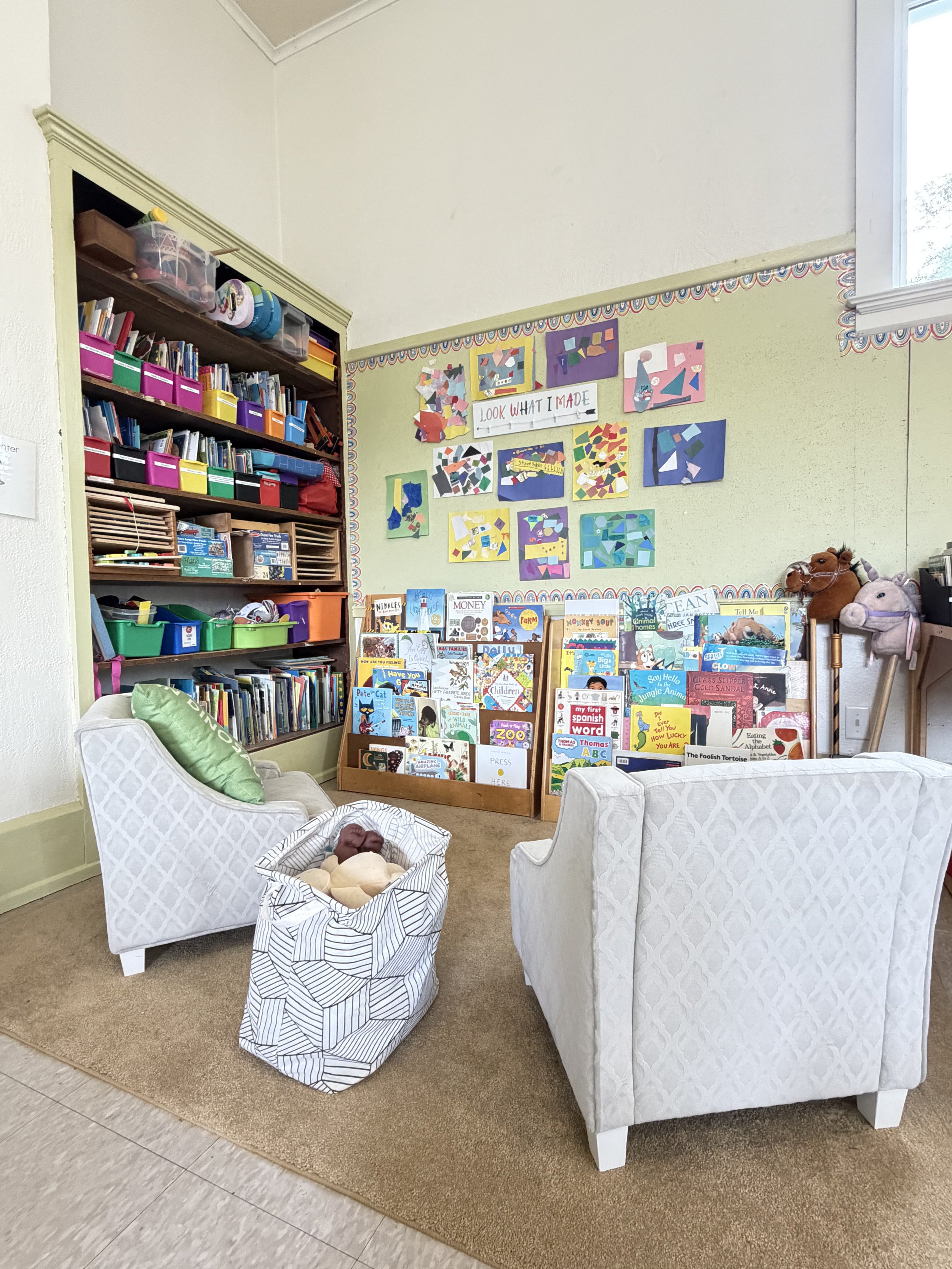
Our Curriculum
At Stone School our curriculum is centered on play-based education. Our developmentally appropriate curriculum model allows children the chance to play and learn together every day. We prepare children for Kindergarten and beyond, helping them learn both academic readiness skills, social skills including group behavior readiness skills, which are equally important for students to learn. We give students a joyful first school experience that encourages them to love learning, and to look forward to school each day.
In a typical day at our preschool, our students are working on:
Reading skills
Writing skills
Math
Science
Fine Motor Skills
Gross Motor Skills
Sensory Development
Group Behavior Skills
Social Skills; including conflict resolution and problem solving
Self-Help Skills; including fostering independence and self-confidence
Sample Daily Schedule
| Time | Activity | Details |
|---|---|---|
| 9:00 AM | Drop-Off, Sign-In, & Choice Time | Children practice holding writing utensils and writing letters and numbers during sign-in, then transition into free choice play. |
| 9:20 AM | Clean-up & Transition | |
| 9:30 AM | Activity Rotations | Small group rotations, including:
|
| 10:15 AM | Teacher Led Carpet Time | Teacher-led activities including:
|
| 10:30 AM | Clean-up & Transition | |
| 10:40 AM | Mystery Bag | Show & Tell — children take turns sharing an item from home and describing it to their classmates. |
| 10:50 AM | Morning Snack | |
| 11:10 AM | Outside Time | Our playground includes:
|
| 12:00 PM | Pick-Up — 9:00 AM–12:00 PM Students |
| Time | Activity | Details |
|---|---|---|
| 9:00 AM | Drop-Off, Sign-In, & Choice Time | Children practice holding writing utensils and writing letters and numbers during sign-in, then transition into free choice play. |
| 9:20 AM | Clean-up & Transition | |
| 9:30 AM | Activity Rotations | Small group rotations, including:
|
| 10:15 AM | Teacher Led Carpet Time | Teacher-led activities including:
|
| 10:30 AM | Clean-up & Transition | |
| 10:40 AM | Mystery Bag | Show & Tell — children take turns sharing an item from home and describing it to their classmates. |
| 10:50 AM | Morning Snack | |
| 11:10 AM | Outside Time | Our playground includes:
|
| 12:15 PM | Lunch | |
| 1:00 PM | Clean-up & Transition | |
| 1:10 PM | Quiet Activities & Reading | |
| 1:30 PM | Choice Time / Outside Time | |
| 2:00 PM | Pick-Up — 9:00 AM–2:00 PM Students |
| Time | Activity | Details |
|---|---|---|
| 9:00 AM | Drop-Off, Sign-In, & Choice Time | Children practice holding writing utensils and writing letters and numbers during sign-in, then transition into free choice play. |
| 9:20 AM | Clean-up & Transition | |
| 9:30 AM | Activity Rotations | Small group rotations, including:
|
| 10:15 AM | Teacher Led Carpet Time | Teacher-led activities including:
|
| 10:30 AM | Clean-up & Transition | |
| 10:40 AM | Mystery Bag | Show & Tell — children take turns sharing an item from home and describing it to their classmates. |
| 10:50 AM | Morning Snack | |
| 11:10 AM | Outside Time | Our playground includes:
|
| 12:15 PM | Lunch | |
| 1:00 PM | Nap / Rest Time | |
| 2:30 PM | Transition / Wake Up | |
| 2:40 PM | Afternoon Snack | |
| 3:00 PM | Science & Literacy Practice | Science (select days):
|
| 3:30 PM | Outside Time | |
| 4:00 PM | Pick-Up — 9:00 AM–4:00 PM Students |
The Research Behind Play-Based Learning
A growing body of research supports the idea that play isn't just a break from learning — it is how young children learn. According to the U.S. Department of Health and Human Services' Office of Child Care, play supports brain development by encouraging exploration, problem-solving, and creative thinking, while also building the physical, social-emotional, and language skills children need for later success in school (Childcare.gov, n.d.).
Research specifically on play-based classrooms backs this up. A study following two groups of children through their first six months of formal schooling — one group attending a school with a play-based curriculum, the other attending schools with a traditional, teacher-directed curriculum — found that the play-based group made significantly greater gains in narrative storytelling ability and complex pretend play (Stagnitti et al., 2016). Notably, the play-based group in this study came from a more disadvantaged community than the comparison groups, based on regional socioeconomic data, and started the study measurably behind on grammar and nonverbal reasoning skills. By the end of the study, that gap had closed entirely — the play-based group's growth in grammar and reasoning matched or exceeded their peers, even though these weren't skills their curriculum explicitly targeted. This suggests play-based learning may support broad academic growth, not just language and storytelling.
A large-scale review commissioned by the LEGO Foundation reached a similar conclusion at a broader, systems level: across eight distinct teaching approaches used in primary schools worldwide (including project-based, inquiry-based, and collaborative learning models), the strongest learning outcomes consistently emerged when lessons were experienced by children as joyful, meaningful, actively engaging, and socially interactive — the same core ingredients that define play (Parker & Thomsen, 2019).
Not all researchers agree on exactly how much credit play deserves, however. A widely cited review in the journal Psychological Bulletin pushed back on some claims about pretend play, finding that while there was reasonably good evidence linking play to gains in language, storytelling, and social-emotional development, evidence for play directly boosting creativity or problem-solving was less conclusive (Lillard et al., 2013). We think it's worth acknowledging this ongoing academic debate — the takeaway isn't that play is a magic bullet for every skill, but that the evidence for its core benefits to language, social development, and self-regulation is genuinely strong.
At Stone School, we take this balanced view to heart. Our program is built around play-based learning, but we also intentionally incorporate foundational academic skills alongside it. Children in our program learn proper pencil grip and how to write all letters of the alphabet in both upper and lowercase, build number recognition and counting skills, and practice calendar and date concepts daily. We believe the research is clear that play and academic skill-building aren't in competition with each other — they work best together, and that's exactly how we've designed our classroom.
References
Childcare.gov. (n.d.). Supporting children's learning through play. U.S. Department of Health and Human Services, Office of Child Care. https://childcare.gov/consumer-education/support-my-childs-health-development/supporting-childrens-learning-through-play
Lillard, A. S., Lerner, M. D., Hopkins, E. J., Dore, R. A., Smith, E. D., & Palmquist, C. M. (2013). The impact of pretend play on children's development: A review of the evidence. Psychological Bulletin, 139(1), 1–34. https://doi.org/10.1037/a0029321
Parker, R., & Thomsen, B. S. (2019). Learning through play at school: A study of playful integrated pedagogies that foster children's holistic skills development in the primary school classroom. Billund: LEGO Foundation.
Stagnitti, K., Bailey, A., Hudspeth Stevenson, E., Reynolds, E., & Kidd, E. (2016). An investigation into the effect of play-based instruction on the development of play skills and oral language. Journal of Early Childhood Research, 14(4), 389–406. https://doi.org/10.1177/1476718X15579741